
Inpi trademark registration
Protecting Your Logo and Brand Guidelines: The Guide to Registering Your Trademark with the INPI in 2026
 MajoliÉquipe de Majoli.io
103,645 trademarks were filed in France in 2025, up 14.1%. The complete guide to protecting your logo and brand guidelines by registering with the INPI in 2026, step by step.
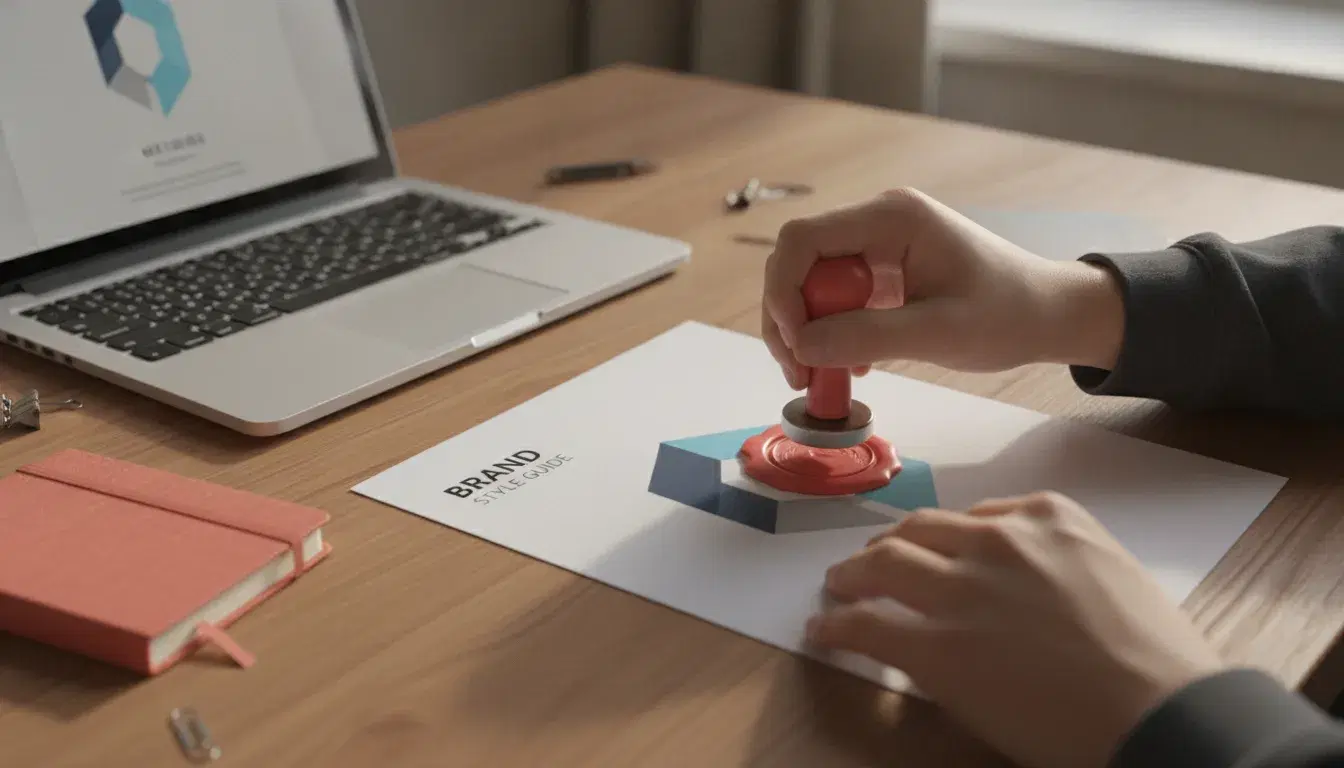
In 2025, 103,645 trademarks were filed with France's national industrial property institute, the INPI, a 14.1% increase in one year and the strongest growth among all industrial property titles tracked by the institute (INPI, 2025 key figures). More and more entrepreneurs understand that a logo and a brand identity are not enough on their own: without registration, nothing stops a competitor from using a name or a visual close to yours, or even legally taking it away from you. Here is the complete method for protecting your visual identity in 2026, step by step.
Why creating a logo and brand guidelines is not enough to protect them
Many small business owners invest time and budget in building their visual identity without ever protecting it legally. The result: a competitor can register a name or a logo close to yours, force you to rebrand after years in business, or simply copy your visual codes with no way for you to react.
Building brand guidelines is a design task. Protecting them is a legal one. These are two separate steps, and it is precisely the confusion between the two that leaves most small businesses exposed.
Trademark and copyright: two complementary protections for your logo
A logo actually benefits from two different protection regimes, worth distinguishing clearly before starting any process.
Copyright protects your creation automatically
As soon as a logo is created and shows a degree of originality, it is automatically protected by copyright, with no formality or registration required. This protection belongs, in principle, to the creator of the logo (the designer or the agency), unless the rights are explicitly transferred to the company. This is why every design contract should include a clause transferring the economic rights to your company: without it, you are not legally the owner of your own logo.
A registered trademark protects your exclusive commercial use
Copyright protects the creation, but not its exclusive commercial use within a given sector. That is the role of trademark registration with the INPI: it grants you a monopoly on the use of your name, logo or slogan for the chosen activities and territory, along with the ability to take legal action against infringement. The two protections stack and complement each other: one arises automatically, the other requires an active application.
Which elements of your visual identity can be registered as a trademark?
A complete set of brand guidelines cannot be registered as such: it is a set of usage rules, not a single legal asset. Several of its components, however, can be.
Word, figurative and semi-figurative marks: what registration covers
The INPI distinguishes several types of trademarks. A word mark protects a name or slogan written in a standard font, regardless of its styling. A figurative mark protects a logo alone, without text: this is the right type of registration for a symbol or pictogram. A semi-figurative mark combines text and graphic design in a precise composition (for example, your name written in your typeface and colors): this is often the most relevant form for a brand identity, but also the most fragile one when the visual evolves, since any substantial change to the design may require a new registration.
Typefaces, colors and pictograms: a separate kind of protection
A standard typeface or a single color generally cannot be registered as a trademark, except in the rare case of a combination that is sufficiently distinctive and has long been associated with a specific brand (cases reserved for large, well-established companies). However, if you commissioned a custom typeface or custom pictograms for your brand guidelines, those creations remain protected by copyright, just like the logo itself.
Trademark registration fees and timeline at the INPI in 2026
Trademark registration is done entirely online through the INPI's official portal, with a per-class fee structure that is identical regardless of the trademark's form (word, figurative or semi-figurative).
- Registration for one class of goods or services: €190
- Each additional class: €40
- Renewal (every 10 years, one class): €290
These figures match the INPI's official fee schedule (INPI, procedure and service fees). As for timing, expect around six weeks for the formal compliance review, two months of public opposition period after publication in the official industrial property bulletin (BOPI), then two to three months of substantive examination before final registration, for a total of five to six months between filing and receiving the certificate.
The 5-step process for registering your logo as a trademark
1. The prior search
Before any filing, check that no identical or too similar trademark already exists in your sector, using the INPI's public database and, ideally, an extended search covering European trademarks (EUIPO). This is the step most often skipped, and the leading cause of rejections or oppositions.
2. Choosing the classes of goods and services
The Nice Classification groups 45 classes covering the full range of economic activities. A registration that is too narrow leaves you unprotected on related activities you might develop later; one that is too broad increases the cost with no real benefit. List your current activities precisely, along with those you plan to develop in the medium term.
3. Filing online
The application is filed on the procedures.inpi.fr portal: applicant's identity, representation of the trademark (name, logo or both), chosen classes, and payment of the fees.
4. Examination and publication in the BOPI
The INPI checks the formal compliance of the application, then publishes it in the BOPI. A two-month period then opens during which third parties (competitors, holders of earlier trademarks) can file an opposition.
5. Final registration
In the absence of an opposition, or once one has been resolved, the trademark is registered for ten years, renewable indefinitely.
The mistakes that weaken a trademark registration
Certain mistakes come up repeatedly among entrepreneurs who file their trademark alone, without support:
- Skipping the prior search, which exposes you to an opposition, or even a forced rebrand after years of operation.
- Registering a name that is too descriptive (for example, a generic name that simply describes the activity), which gets rejected or is easily challenged for lacking distinctiveness.
- Choosing classes that are too narrow, leaving activities the company will develop later without protection.
- Forgetting to renew every ten years: an unrenewed trademark falls into the public domain and can be claimed by a third party.
- Failing to monitor new filings in your sector after registration, when this is the only way to detect infringement in time and file an opposition within the two-month legal deadline.
Should you register your trademark before or after a logo redesign?
If you are planning a logo redesign, it is better to finalize the new visual before registering, since any significant change to your figurative or semi-figurative mark generally requires a new filing. Conversely, if your word mark (the name) stays stable, it can be registered now, independently of upcoming graphic changes. This is also the right time to check that your brand kit is complete and that the contract signed with your designer or agency does include a transfer of copyright, since without it, registering with the INPI alone will not fully secure your visual identity. Also consider protecting your domain name at the same time: a registered trademark and a matching domain name form a coherent protection base.
To build or redesign a visual identity ready to be registered, with distinctive color and typeface choices, it is often worth getting support: discover Majoli's graphic design mockups and design studio services, or contact our team to discuss your project.
Frequently Asked Questions
Does registering a domain name protect my logo?
No. Reserving a domain name only guarantees you the use of that web address, not any rights over the name or logo as a trademark. A competitor can register your name as a trademark even if you hold the matching domain name, and then force you to change your web address. The two steps are complementary and should be carried out in parallel.
Can I file my own trademark without a lawyer or an industrial property attorney?
Yes, online filing through procedures.inpi.fr is accessible to any entrepreneur. But the prior search, the choice of classes, and the wording of the list of goods and services are technical steps where a mistake can permanently weaken the protection or lead to a rejection. Support from an industrial property attorney remains recommended beyond a straightforward filing.
What happens if I do not register my trademark?
Without registration, you have no legal monopoly on your name or logo, even if you have used them for years. A third party can register an identical or similar trademark and formally demand that you stop using your own visual identity. The only possible recourse without registration, the doctrine of prior use, is difficult to prove and costly to enforce in court.
Is protection automatically valid across all of France?
A filing with the INPI protects your trademark across the entire French territory. For protection at the European Union level, you need to file with the EUIPO (the European office), which has a separate procedure and fee schedule, relevant if you are expanding your business beyond French borders.
Do I need to renew my trademark even if my logo changes slightly?
A minor evolution of your logo (adjusting proportions, a shade of color) generally does not require a new filing as long as the distinctive elements remain recognizable. However, a significant change in composition or name requires a new filing, since protection applies precisely to the representation originally registered.
Read next

October 20, 2026
Automating the professional inbox in small businesses: the method to sort, prioritize and reply without losing your whole day in 2026
117 emails and 153 messages received daily according to Microsoft (2025). The 5-step method to automate a work inbox in a small business without losing control.
October 20, 2026
Automating the professional inbox in small businesses: the method to sort, prioritize and reply without losing your whole day in 2026
117 emails and 153 messages received every day according to Microsoft (2025). The 5-step method to automate a professional inbox in a small business, without losing control or the client relationship.

October 19, 2026
AI Chatbot Agency for Small Businesses: How to Choose the Right Solution in 2026
24% of French small businesses already use AI for their chatbots and assistants (France Num 2026). The 7 criteria for choosing the right agency or solution, real budgets, and pitfalls to avoid.