Brand kit
Brand Kit: The Complete Checklist of Essential Elements in 2026
 MajoliÉquipe de Majoli.io
Brand consistency increases revenue by 10 to 33 percent according to a Lucidpress study, yet 70 percent of companies fail to apply their own graphic rules. The complete checklist for building a brand kit your team actually uses.
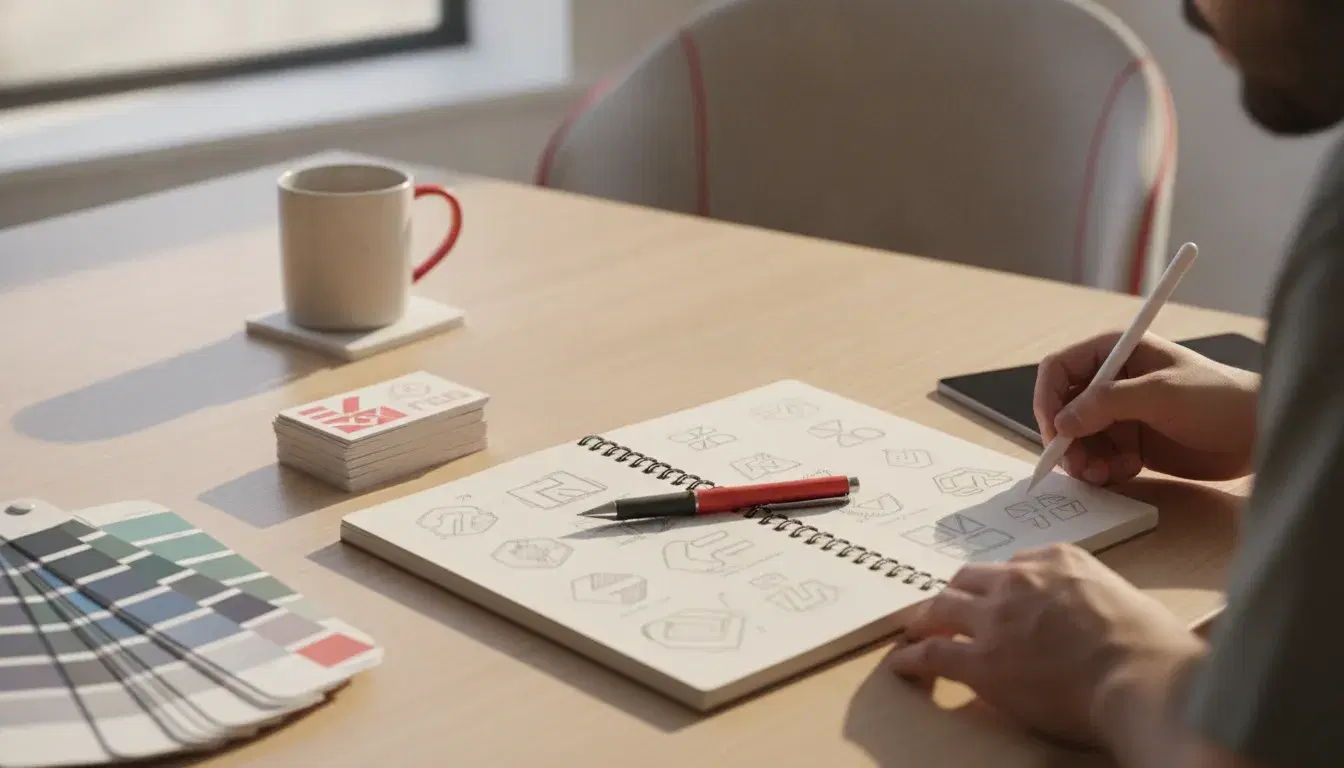
A logo alone does not make a brand. Many small business owners believe they have "a visual identity" because they have a logo and two or three colors picked by feel. Then comes the day they need to create a LinkedIn banner, print business cards, or brief a new supplier, and nothing lines up: colors shift from one medium to another, the font changes depending on who made the document, the logo shows up blurry or badly cropped. The problem is not the logo. It is the absence of a complete brand kit.
According to Lucidpress (Marq)'s reference study State of Brand Consistency, presenting a brand consistently across every channel can increase revenue by 10 to 33 percent, and 68 percent of the companies surveyed confirmed that this consistency directly contributed to their growth. The paradox, revealed by Capital One Shopping Research in its Branding Statistics study, is that 95 percent of companies do have brand guidelines, yet only 25 to 30 percent actually apply them day to day. In other words: the style guide often exists, but it gathers dust in a folder instead of being used. Here is what a brand kit needs to contain to be genuinely usable, and how to keep it alive over time.
What exactly is a brand kit?
A brand kit goes further than a classic style guide. A style guide describes rules: which colors, which fonts, which logo proportions. A brand kit also delivers ready-to-use files that let anyone apply those rules without design skills: logo variations in every format needed, social media post templates, an email signature template, a PowerPoint or Google Slides deck template.
That difference is exactly why so many style guides end up unused: they explain the theory without providing the tools. A brand kit, on the other hand, fits directly into a team's daily work, even without an in-house designer.
The essential components of a brand kit in 2026
The logo and its variations
A single logo file delivered as a PNG is no longer enough. A complete brand kit must include, at minimum, the main color version, a monochrome (black and white) version for media where color cannot be reproduced, a reversed version for dark backgrounds, and a simplified icon or favicon for very small formats (app icon, social media avatar). Every variation should be delivered as a vector file (SVG or AI) so it stays sharp at any size, in addition to the usual PNG and JPG exports.
The color palette
Two or three primary colors, paired with two or three secondary or neutral colors for backgrounds and text. Every shade should be documented in the four systems relevant to each medium: HEX for the web, RGB for screens, CMYK for print, and ideally a Pantone reference if large print runs are planned. Without these exact codes, every new supplier reinvents its own shade, and the brand loses consistency with every new piece of material produced.
Our dedicated article details the method for choosing the colors of a style guide without getting it wrong.
Typography
Two fonts are enough in most cases: one for headings, one for body text, with their weights (light, regular, bold) and recommended minimum sizes for each medium. A fallback font should also be planned for the web, in case the primary font fails to load correctly. The topic is covered in detail in our guide on choosing the typography of a style guide.
Secondary graphic elements
Icons, patterns, dividers, a defined photography or illustration style: these elements give a recognizable visual signature that goes beyond the logo alone. Many small businesses overlook them, even though they are often what makes an Instagram post or a web page instantly identifiable, even without the logo visible on screen.
Ready-to-use templates
This is the most useful part on a daily basis, and the one most often missing from classic style guides: post templates for every social network in use, a harmonized email signature template for the whole team, a sales presentation template, and a document template (quote, invoice, report) in the company's colors. These are the files that turn a theoretical style guide into a tool actually used by sales, marketing, and HR teams.
The usage guide
Finally, a short document (ten pages is enough for a small business) that gathers all the rules above and, just as important, an explicit list of forbidden uses: never stretch the logo, never place it on a background color that is too close to it, never use an unapproved font. It is often this simple, concrete list of prohibitions that prevents the most everyday mistakes.
How to have your brand kit created: a 4-step method
- Frame before drawing. A clear brief on the company's values, target audience, and competitors to avoid resembling saves costly back-and-forth later.
- Explore before deciding. A serious designer proposes several creative directions (moodboards, logo sketches, palette tests) before settling on one.
- Document, not just design. Creating the logo is only half the work: the usage guide and the variations must be delivered with it, not treated as optional extras.
- Deliver all source files. Editable vector files (AI, SVG, EPS), not just PNG exports. Without these files, any future modification means starting from scratch.
For a visual identity designed in step with the company website (not just for print), our graphic mockups support covers every one of these steps, from creating the logo through to ready-to-use templates. To discuss your project, our team can be reached via the contact page.
The mistakes that cost a small business dearly
- Receiving only PNG files. Without a vector version, it is impossible to enlarge the logo for a storefront sign or a roll-up banner without losing quality.
- Forgetting the mobile and social media versions. A logo designed only for a website header often renders poorly as a square app icon or avatar.
- Letting every team member design their own visuals. Without templates or a usage guide, every post, every quote, every presentation drifts a little further from the original identity.
- Neglecting consistency between the website and the visual identity. As our article on how a consistent design increases visitor trust points out, an identity that varies between the website, social media, and sales documents weakens the company's perceived credibility.
Keeping your brand kit alive over time
A brand kit is not a fixed deliverable. It should be stored in a shared space accessible to the whole team (not just the owner's inbox), with a version that is always up to date and a clearly indicated last revision date. It is recommended to review it every two to three years, not to change everything, but to check that it still matches the company: a logo designed for a local craft business no longer necessarily fits once the company has grown to a national scale.
The signs that a refresh is needed are detailed in our article on the signals that show a logo is holding back a company's growth. Conversely, an identity that has proven itself should not be changed to follow a trend: it should be enriched, with new templates or a secondary palette, without starting from zero.
Finally, this brand kit must be designed hand in hand with the company website, as our article on visual identity and mobile-first design points out: a website that does not faithfully apply the style guide's colors and typography gives an impression of improvisation, even if the rest of the digital strategy is solid.
Frequently asked questions
What is the difference between a logo, a style guide, and a brand kit?
The logo is a single visual element. The style guide is the document that sets the rules for using all the visual elements (logo, colors, typography). A brand kit goes further by delivering, in addition to the rules, ready-to-use files (social media templates, email signature, presentations) that let the rules be applied day to day without design skills.
How long does it take to create a complete brand kit?
Generally allow several weeks between the initial brief, the creative exploration phases, the review rounds, and the final delivery of the files. Timelines mostly depend on how many templates are requested (social media, sales documents, presentation) and how quickly internal approvals move within the company.
Can a small business create its own brand kit without a designer?
It is possible for a simple first version using online tools, but the result often lacks consistency over time: without logo clear-space rules, vector variations, or a precise usage guide, the style guide quickly erodes as different people produce different materials. Bringing in a professional becomes worthwhile as soon as the company multiplies its communication materials or starts hiring.
Does the whole brand kit need to be redone if only the logo needs to evolve?
No. A logo evolution can be treated as an adjustment rather than a full redesign: keeping the color palette and typography already recognized by customers, and modernizing only the logo's outline, limits the risk of losing brand recognition while still refreshing the company's image.
Which files should you absolutely require from a designer or agency?
The source vector files of the logo (editable AI, EPS, or SVG), high-definition PNG exports with a transparent background, the usage guide as a PDF, and the color codes in all four systems (HEX, RGB, CMYK, Pantone). Without these source files, any future modification of the logo will mean starting from scratch.
Read next
September 30, 2026
Automating Electronic Signature and Document Management for SMEs: The Complete 2026 Method
26% of small businesses now use electronic signature (Yousign/Ipsos, 2025), up from 19% in 2021. The complete method to automate signature and document management without losing compliance.

September 29, 2026
AI for Small Businesses: Automating Quotes and Payment Reminders to Get Paid Faster in 2026
26% of French SMEs use AI in 2025, up from 13% in 2024 (France Num). The 5-step method to automate quotes and payment reminders with AI and cut payment delays in 2026.

September 28, 2026
Marketing Automation for Small Businesses: How to Convert Prospects Without Spending Your Days on It in 2026
79% of marketing leads never buy due to lack of follow-up (Forceplus). A 5-scenario method to automate prospecting and convert more, without the daily grind, in 2026.