
Logo creative brief
How to Brief a Graphic Designer: The Creative Brief for a Successful Logo and Visual Identity
 MajoliÉquipe de Majoli.io
80% of back-and-forth exchanges with a designer come from a poorly prepared brief (BTG Communication). The 6-step method for writing a creative brief that delivers the right logo from the first proposal.
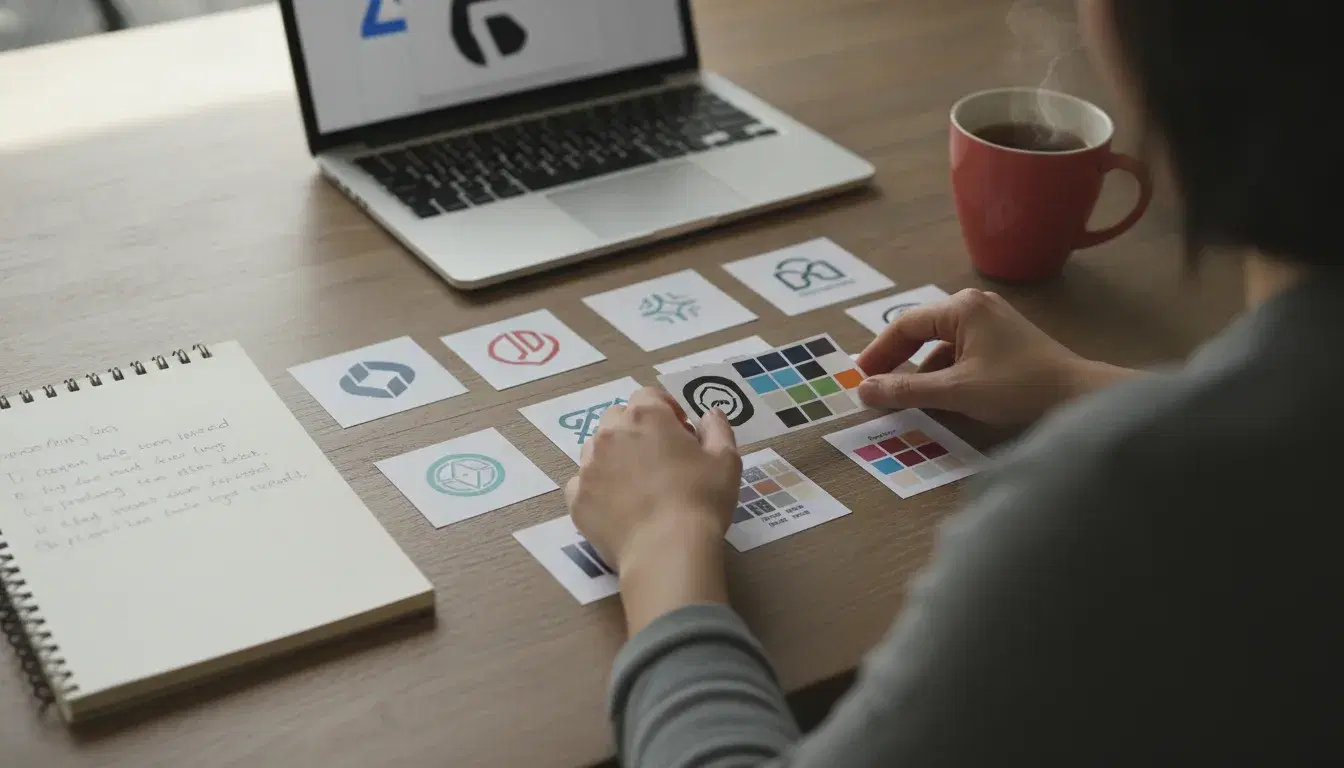
A logo that doesn't match what the founder had in mind, endless back-and-forth with the designer, a budget that explodes because everything has to be "redone": in most cases, the problem isn't the designer's talent. It's a creative brief thrown together in ten minutes right before the first meeting. According to BTG Communication, a well-built creative brief avoids up to 80% of back-and-forth exchanges with the designer and cuts the number of revision rounds in half. Here is the complete method for writing a brief that produces the right visual identity on the first try, whether you're creating a logo from scratch or preparing a rebrand.
Why the creative brief changes the entire outcome
A graphic designer cannot read your mind. Without clear direction, they have to guess your expectations, produce several directions "just in case," then wait for your feedback before adjusting. Every round of back-and-forth costs billed time and pushes back delivery. A complete brief, by contrast, lets the designer target the right creative direction from the very first proposal.
It's also a useful exercise for the business owner: writing a brief forces you to clarify what the company actually offers, who it's for, and what genuinely sets it apart from competitors, before even thinking about colors or fonts. A poorly framed project from the start explains a large share of the logo redesigns that have to be revisited just months after launch.
The 6 pillars of a complete visual identity brief
An effective brief isn't just "I want a modern, clean logo." It covers six dimensions, in this order.
1. The company's DNA
Precise line of business, history, mission, values, and what genuinely differentiates the company from competitors. A designer cannot visually translate a positioning you haven't yet put into words.
2. The target audience
Age, socio-professional category, buying behavior, brands they otherwise consume. A logo aimed at construction tradespeople and one aimed at law firms don't follow the same visual codes, even if both target professional clients.
3. Competitors and market codes
Listing 3 to 5 direct competitors along with their visual materials helps the designer identify the dominant codes in the sector and, more importantly, decide whether to follow them or deliberately stand apart. This is often the most overlooked section, even though it's what prevents ending up with a logo that looks like the one next door.
4. Positioning
Entry-level or premium, local or national footprint, traditional or innovative posture: these dials directly shape the graphic style (typography, shapes, palette) well before any aesthetic choice is made.
5. Technical constraints
Available budget, intended uses (website, signage, vehicles, social media, packaging), mandatory formats, deadlines. A logo designed only for a screen doesn't always translate well onto physical signage or printed materials, so it's better to know that from the brief stage.
6. Visual preferences, in both directions
Preferred graphic style (minimalist, organic, vintage, geometric), preferred colors and typography, but also everything explicitly rejected. Spelling out the "no-gos" (a color associated with a competitor, a typeface considered overused) saves as much time as spelling out what you like.
The moodboard: show, don't just describe
Words like "modern," "dynamic," or "clean" don't mean the same thing to everyone. A moodboard of 3 to 5 visual references (logos from other industries, mood images, photos, color palettes) removes that ambiguity and gives the designer a concrete starting point. Always specify what you like about each reference: is it the color, the shape, the simplicity, the energy? A single image left unexplained is just as open to interpretation as an adjective.
A brief that clearly defines the limits (what you don't want) often saves more time than a brief that only describes what you do want.
The mistakes that sabotage a brief, even a well-intentioned one
- Filling it out alone, in ten minutes: a serious brief takes on average 1.5 to 2 hours of thought, often involving one or two colleagues in the decision.
- Confusing inspiration with copying: showing a competitor's logo as a reference without specifying what to take from it almost always leads to a result too close to the original.
- Involving too many decision-makers without a clear hierarchy: when three people give contradictory feedback at every step, the project stalls. Appoint a single point of contact for sign-off on the company side.
- Forgetting future use cases: thinking only about the website, then discovering six months later that the logo doesn't work in black and white on an invoice or at small size as a favicon.
- Not setting a budget from the start: the cost of a logo and brand guidelines varies widely depending on scope; stating it in the brief avoids receiving proposals that are out of budget.
Creative brief for a new logo versus a rebrand: what changes
For a rebrand, the brief needs a seventh dimension: what to keep from the current identity. A company that has existed for ten years has built visual recognition, even an imperfect one. The brief should specify which elements to preserve (a signature color, a recognizable shape) and which to modernize, to avoid too abrupt a break with existing customers. This is a point that companies undertaking a rebrand often overlook, even though it determines how well the new logo is accepted both internally and externally.
After the brief: framing approvals to limit back-and-forth
The brief alone isn't enough; it needs to be paired with a clear approval process. Plan for a defined number of initial proposals (2 to 3, rarely more), a limited number of revision rounds included in the quote, and a single point of contact authorized to approve each stage. Feedback should be argued against the original brief ("this doesn't match the premium positioning defined in section 4") rather than expressed as personal taste ("I don't like it"), which lets the designer correct the right variable instead of guessing again.
Once the logo is approved, remember to protect your work: registering your trademark with the INPI secures the visual identity you just had built, before a competitor gets too close to it.
If writing this document on your own feels complex, or if you'd rather be guided to turn this brief into concrete graphic mockups, a specialized visual identity studio can steer the whole process with you, from brief to final delivery.
Frequently asked questions
How long does it take to write a visual identity brief?
Plan for an average of 1.5 to 2 hours for a complete, well-thought-out document. A brief filled out in fifteen minutes usually produces answers too vague to effectively guide the designer, which then translates into more back-and-forth and more revisions.
Should you show competitors' logos to the designer?
Yes, but specify what you're keeping or rejecting from each one. A list of 3 to 5 competitors with their visual materials helps the designer map the sector's codes and decide whether to follow them or stand apart, rather than starting from a blank page with no reference point.
Who should approve the logo within the company?
A single point of contact, ideally the owner or a manager designated in advance. Involving too many decision-makers without a clear hierarchy between them is one of the main causes of delays and contradictory feedback on this type of project.
Is the brief different for a logo redesign than for a new creation?
Yes. For a redesign, you need to add a section on what to keep from the current identity (a signature color, a recognizable shape) in order to modernize without losing the recognition already built up with existing customers.
Can you write the brief yourself, without design experience?
Yes, this document requires no design skills: it's mainly about clearly stating your business, your audience, your positioning, and your preferences. It's then up to the designer to translate these elements into visual proposals.
Read next
September 28, 2026
Marketing Automation for Small Businesses: How to Convert Prospects Without Spending Your Days on It in 2026
79% of marketing leads never buy due to lack of follow-up (Forceplus). A 5-scenario method to automate prospecting and convert more, without the daily grind, in 2026.

September 24, 2026
Business Domiciliation and Professional Bank Accounts: What to Know in 2026
Since 2023, the Kbis extract is no longer required to open a professional account. The complete guide to domiciling your company and opening a business bank account without surprises in 2026.

September 23, 2026
Automating Expense Report Management in Small Businesses: The Method to Save Time and Secure Reimbursements in 2026
Employees spend an average of €2,496 a year on business expenses (Expensya, 2024), often processed by hand. The 5-step method to automate expense report management in small businesses in 2026.