Ai inventory management
AI and Inventory Management for Small Businesses: How to Forecast Demand and Automate Replenishment in 2026
 Majdi ZarkounaCo-fondateur de Majoli.io
18% of French companies now use artificial intelligence (Insee). The 5-step method to forecast demand and automate replenishment, without an expensive ERP, for small businesses.
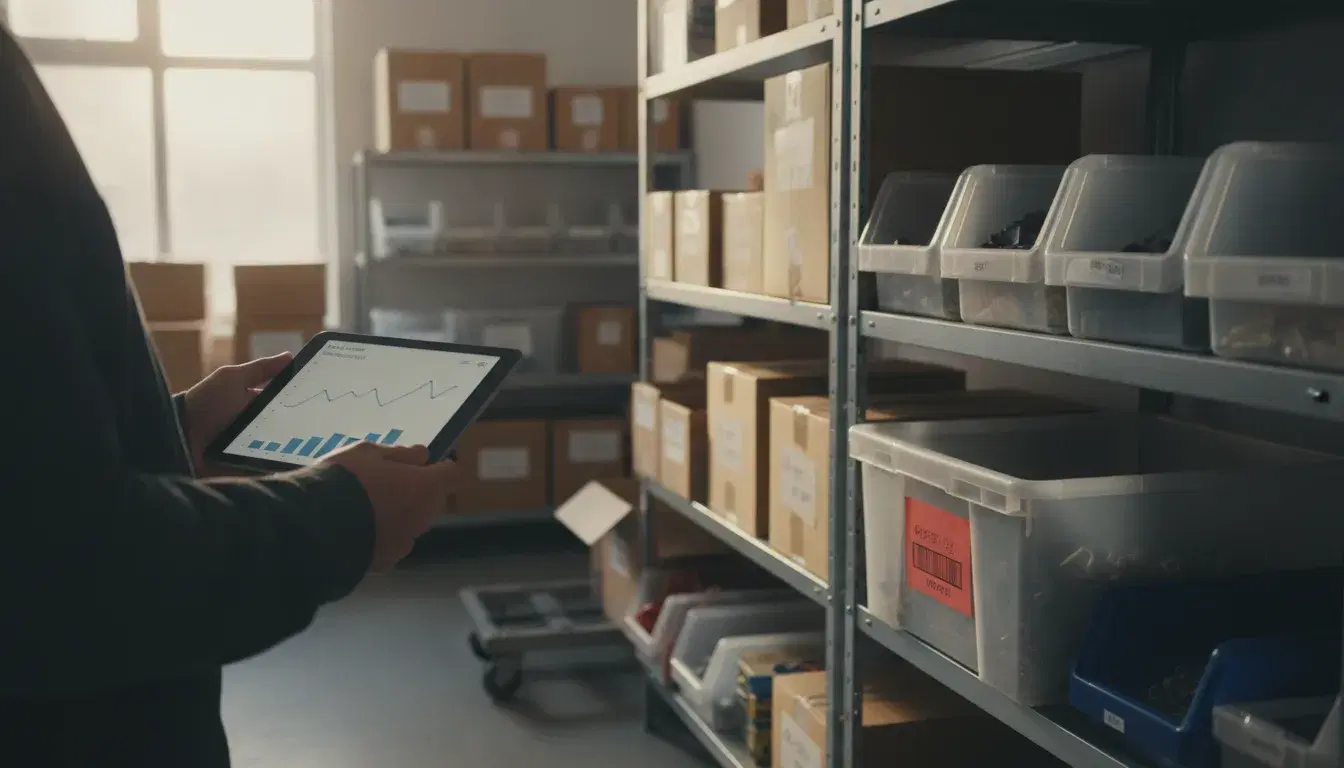
Eighteen percent of companies based in France now use at least one artificial intelligence technology, up from 10 % a year earlier, according to Insee. The growth is real, but it is very uneven across use cases: content generation and conversational assistants dominate, while a function as concrete as inventory management is still largely lagging in small and mid-sized businesses. Yet this is ground where AI has proven itself for years in large companies, and where tools accessible to small structures have multiplied. Here is the method for moving from gut-feeling inventory management to demand forecasting and replenishment driven by data.
Why inventory management remains a blind spot of AI adoption
According to an infographic published by software vendor Cegid, two out of three small and mid-sized businesses regularly face inventory piloting errors: stockouts, overstock or late deliveries. These errors carry a direct cost, cash tied up in slow-moving items, lost margin on a sale that cannot be fulfilled, and an even heavier indirect cost: a customer who cannot find the expected product often looks elsewhere, and does not always come back. Globally, the IHL Group estimates that stockouts and overstock combined cost retailers close to 984 billion dollars every year.
Despite this, inventory management rarely ranks among the first AI use cases cited by small business owners. The reason is simple: unlike a chatbot or a content generator, the topic looks technical, tied to an expensive ERP, reserved for large warehouses. That is a misconception. AI-driven forecasting methods have become widely accessible and are now built into business management tools within reach of companies with just a handful of employees.
What AI actually changes compared to traditional methods
Most small and mid-sized businesses still manage inventory with moving averages or, more simply, with the owner's gut feeling: "we know we sell more in December." This approach works as long as activity stays stable, but it quickly hits its limits once several factors combine: seasonality, promotional campaigns, a new product launch that cannibalizes sales of another.
A forecast based on AI (machine learning applied to sales history) takes these variables into account simultaneously, item by item, and automatically adjusts the reorder point based on actual demand and supplier lead time. It does not replace the owner's judgment: it gives them a continuously updated, data-driven basis to make decisions faster.
The five-step method for moving to AI-driven forecasting
Step 1: make your sales data reliable before choosing any tool
No algorithm compensates for dirty data. Before choosing a tool, make sure you have a clean sales history, by item and by sales channel, deep enough to capture seasonality (generally 18 to 24 months). One point often overlooked: you must distinguish a stockout from a genuine absence of demand. If a product was out of stock for three weeks, the zero sales during that period must not be read as "nobody wanted it," or the forecast will be permanently distorted.
Step 2: define your target service level
Before chasing perfect precision, set the service level you are aiming for by product family: a 98 % availability rate for your best-selling items does not cost the same as a 90 % rate on a secondary range. It is this service level, combined with the historical volatility of demand, that determines the safety stock to hold, not the other way around.
Step 3: choose the right level of tool for your size
You do not need to deploy a complex system on day one. Three levels coexist and can follow one another:
- A simple reorder-point rule, based on average demand, its standard deviation and supplier lead time, is often enough to get started and can be kept in a spreadsheet.
- A forecasting module built into your business management software or point of sale, which already applies statistical or machine-learning models with no custom development needed.
- A specialized demand-forecasting solution, relevant once you reach a catalog of several hundred items or multi-site needs.
For the vast majority of small and mid-sized businesses, the second level offers the best balance between implementation effort and results. Support with artificial intelligence for small and mid-sized businesses helps frame this choice without multiplying tools.
Step 4: automate replenishment, not just forecasting
Forecasting alone is not enough if it remains information nobody acts on. The next step is to connect this forecast to an alert or a semi-automatic order: as soon as available stock crosses the calculated reorder point, a replenishment proposal is generated, with a suggested quantity. The owner or purchasing manager keeps final approval, but the mental load of monitoring disappears.
Step 5: close the learning loop by comparing forecast and actuals
A forecast is never set in stone. The central challenge is not finding the perfect algorithm, but installing a regular loop: comparing the forecast to actual results every month, measuring the gap, adjusting the parameters. It is this discipline, more than the sophistication of the model, that makes the difference over time.
What concrete gains to expect, and at what pace
Documented orders of magnitude give an idea of the potential, to be scaled down to a small business. Nucleus Research found that companies using inventory optimization tools reduce their tied-up inventory levels by 10 to 30 %. In a client example documented by McKinsey, moving to demand forecasting based on advanced analytics delivered a 5 % sales increase, thanks to better product availability, and a 15 % inventory reduction.
These figures come from varied deployments, often in companies larger than a small business. They are not an automatic promise, but they point in a consistent direction: less capital tied up in poorly adjusted inventory, and fewer sales lost to stockouts. For a small business, the first effects are generally measurable over two to three replenishment cycles, the time it takes for the learning loop to fine-tune the parameters.
Mistakes to avoid when getting started
- Trying to automate everything in the first month. Start with your highest-turnover or highest-margin items, not your entire catalog.
- Neglecting the quality of the product reference data. A forecast built on a history where labels and units change from month to month will never be reliable, whatever the tool.
- Ignoring exceptional events. A one-off promotional campaign or a supplier shortage must be flagged to the tool so they do not pollute the reference history.
- Underestimating actual supplier lead time. Many stockouts come from a poorly recorded delivery lead time, not from an error in demand forecasting itself.
When to get outside support rather than building everything in-house
Setting up AI-driven forecasting and automated replenishment means choosing the right tool, connecting it to your existing management system, and training the team on the follow-up loop. For a small or mid-sized business without dedicated technical resources, outside support helps avoid the two most common pitfalls: choosing a tool oversized for the actual volume of items, or starting without making the underlying data reliable first. It is also an opportunity to connect this project to other AI use cases already under way in the company, whether that is cash flow forecasting or automated bookkeeping, so that data flows between these functions instead of staying siloed.
If your business relies partly on online sales, the question of inventory arises from the design of the site itself: see our article on the essential features of an e-commerce site to see how inventory and online sales fit together technically. And if you want to go further in automating other repetitive tasks in your business, our articles on autonomous AI agents and AI-driven competitive monitoring complete this approach.
AI forecasting does not replace the owner's decision: it gives them, item by item, an up-to-date, data-driven basis to decide faster and get it wrong less often.
Need help seeing clearly which tools fit your volume of items and your current management system? Contact our team for a conversation about your situation.
Frequently asked questions
Do you need an ERP to use AI for inventory management in a small business?
No. Many business management or point-of-sale software tools aimed at small businesses now include machine-learning-based forecasting modules, with no need for a full ERP. An ERP becomes relevant once the volume of items and flows grows larger, or when several sites need to be coordinated.
How long does it take to see results after setting up AI-driven forecasting?
The first effects are generally measurable over two to three replenishment cycles, the time it takes for the learning loop (comparing forecast to actuals, adjusting parameters) to refine results for your best-selling items. A sales history of 18 to 24 months, when available, speeds up this fine-tuning.
Can AI completely replace an inventory manager in a small business?
No. AI automates the forecast calculation and reorder-point detection, but approving orders, handling exceptional events (promotions, supplier shortages, new products) and the relationship with suppliers remain the responsibility of someone who knows the business.
What data is essential before getting started?
A clean sales history by item and by channel, actual supplier lead times, and a clear flag on past stockout periods, so they are not mistaken for an absence of demand. Without these three elements, no forecasting tool can produce reliable results.
What signals indicate it is time to move to AI rather than manual rules?
Three signals come up often: the time spent each week manually adjusting orders becomes disproportionate to the business's activity, stockouts or overstock keep recurring on the same items despite manual adjustments, and the item catalog has grown past the size one person can track from memory or in a simple spreadsheet.
Read next

October 12, 2026
Automating Leave and Absence Management in Small Businesses: The Method and Legal Rules to Know in 2026
57% of HR time goes to repetitive tasks (Deloitte). Legal notice periods, order of departures, payroll links: the complete method to automate leave management in small businesses in 2026.

October 9, 2026
How to Advertise Your Business for Free: The Complete Method for Small Businesses in 2026
98% of consumers search online for a local business every year (BrightLocal). Google Profile, reviews, social media, SEO: the complete method to advertise your small business for free in 2026.

October 8, 2026
How to Measure Your Website's ROI: Method and Key Indicators in 2026
SMEs spend over 5,000 euros a year on average on their digital presence (Afnic). Formula, worked example and key indicators to find out whether your website actually pays off in 2026.