Multilingual website
Multilingual Website: The Complete Guide to Selling Internationally in 2026
 MajoliÉquipe de Majoli.io
76% of online shoppers prefer buying in their native language (CSA Research). URL architecture, hreflang tags, translation and budget: the complete guide to building an effective multilingual website in 2026.
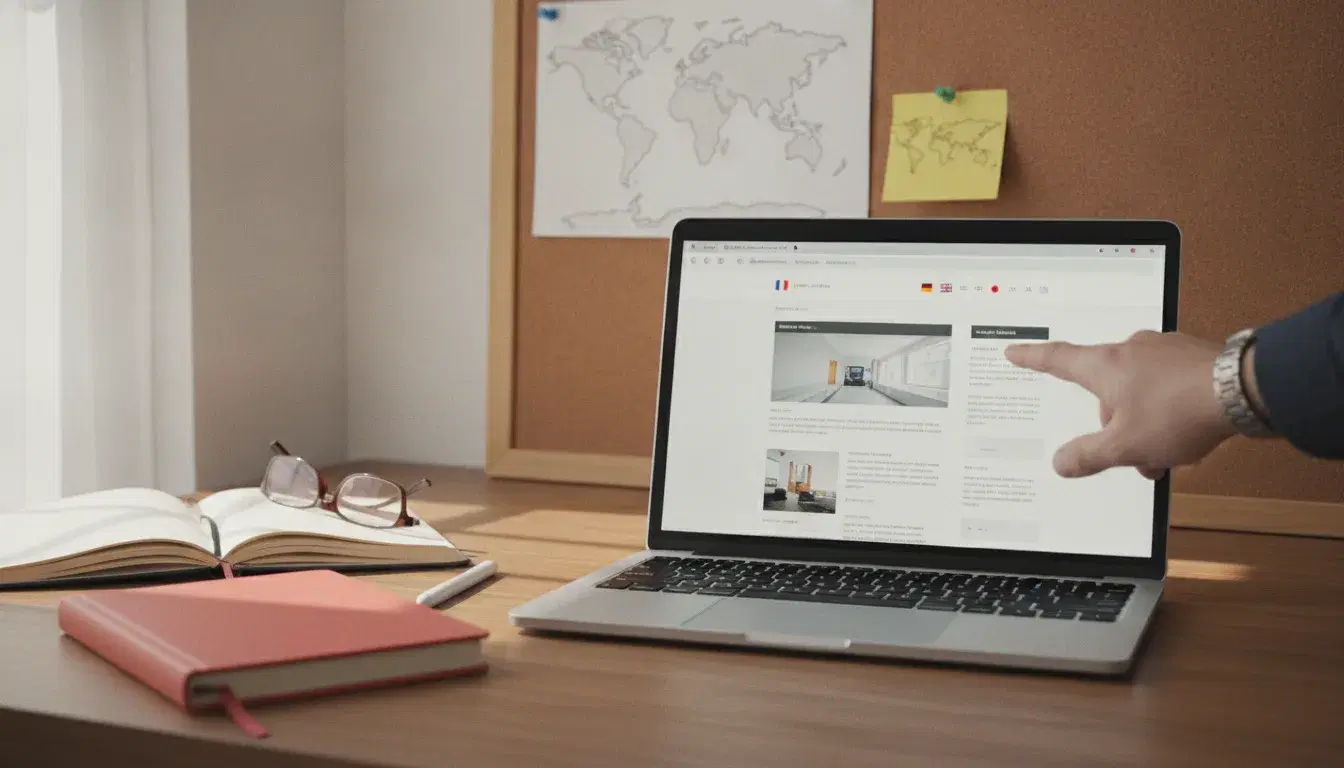
24% of French small and medium businesses plan to export in 2026, according to the latest barometer from Bpifrance Le Lab. Yet most of them still present their offering on a website available in a single language. This is an invisible but very real barrier: according to the landmark CSA Research study of 8,709 consumers across 29 countries, 76% of online buyers prefer to purchase a product with information written in their native language, and 40% will never buy from a website written in another language. Going international without a multilingual website effectively closes the door on a large share of potential customers before the first contact is even made.
This guide details how to build a multilingual website that genuinely supports international growth: technical architecture choices, hreflang tag implementation, the difference between translation and localization, a realistic budget, and how to verify results after launch.
Why a multilingual website changes the game for selling internationally
France counted 152,500 exporting companies in the third quarter of 2025, a record level according to Bpifrance Le Lab, with small and medium businesses representing 98.6% of these exporting companies. Yet they generate only 14.7% of total export revenue: internationalization remains a major challenge for smaller structures, often held back by very concrete issues, including a digital presence in the language of the target market.
Conversion figures confirm the business stakes. Still according to CSA Research, when two similar products are offered, 76% of respondents choose the one whose page is in their language, a rate that climbs to 89% among people with no English proficiency. And 75% of consumers say they are more likely to buy again from a brand whose customer service speaks their language. A multilingual website is therefore not a mere comfort feature: it is a measurable lever for conversion and loyalty.
On the destination side, the European Union remains the primary market for exporting French small and medium businesses (86% plan activity there), but 61% also target markets outside the EU. This diversity of markets often means managing more than two languages, which makes the choice of technical architecture decisive from the very start.
Subfolder, subdomain or dedicated domain: which architecture to choose
This is the first structuring decision, and it should ideally be made before even drafting the website specification document, since revisiting it later is costly in both time and search rankings.
The subfolder (example.com/en/, example.com/de/)
This is the simplest solution to implement and the most recommended for a small business starting its international journey. Every language version benefits from the domain authority already built by the main site, which speeds up indexing of new pages. It is also the least expensive structure to host and maintain.
The subdomain (en.example.com, de.example.com)
It allows for a clearer separation of content, sometimes useful when each market is managed by a different team or provider. In return, search engines may treat each subdomain as a distinct entity, which slightly dilutes the site's overall authority until each version has built its own visibility.
The country-specific domain (example.de, example.co.uk)
This is the heaviest option to manage (hosting, certificates and maintenance are all multiplied), but it sends the strongest geographic signal to search engines and reassures certain markets where a local domain inspires more trust. It is mainly worth it for a company already well established in a specific market, with a volume of activity that justifies the investment.
For the vast majority of small and medium businesses starting their international development, the subfolder remains the most effective compromise between cost, ease of management and SEO performance.
The hreflang tag: the technical detail that can sabotage your own rankings
Once the architecture is chosen, the hreflang tag is the most decisive technical element, and the one most often implemented incorrectly. It tells search engines which language and geographic version of a page to show a visitor based on their language and location. According to Google Search Central, correct implementation strongly reduces the risk of duplicate content between versions of the same site, something technical SEO alone cannot fix if the underlying hreflang setup is missing or wrong.
Implementation best practices
- Every page must reference, through a
<link rel="alternate" hreflang="x">tag, all other existing language versions, including itself (reciprocal referencing). - Use the correct ISO format: language code alone (
en) or language-region (fr-befor French-speaking Belgian content that differs from content aimed at France). - Check consistency after every content update, since a page removed or moved in one language breaks reciprocity for every other version.
The often-forgotten role of the hreflang x-default
The x-default value indicates the page to display by default to visitors whose language or region doesn't match any version targeted explicitly (a Japanese visitor on a site that only offers French and English, for example). Many multilingual sites forget it, which leaves search engines to pick arbitrarily which version to show these visitors, often at the expense of user experience and bounce rate.
Translating or localizing: the difference that drives conversion
A word-for-word translation, even a good one, is not always enough to convince a foreign buyer. Localization goes further: adapting units, currencies, date formats, cultural references, visuals and sometimes the sales pitch itself to the target market's norms. A translated but poorly localized site keeps a tone and references that reveal its origin and can undermine trust, particularly in markets where the relationship to brands and customer service differs sharply from the French market.
Raw automatic translation of a professional website remains risky on high-value commercial pages (product pages, contact pages, legal notices): a human review by a native speaker familiar with the industry limits the meaning errors that damage credibility.
In practice, a pragmatic mix works well for most small and medium businesses: professional translation for strategic pages (home, offering, contact) and assisted translation tools reviewed at minimum for secondary content or blog posts, with a dedicated proofreading budget for languages where the company targets significant business volume.
How much does a multilingual website cost and how to budget it
The budget for a multilingual website breaks down into two distinct components that should be costed separately: the technical design of the site (multilingual structure, language switcher, URL management) and the actual translation of content.
- Professional translation: expect generally between €0.08 and €0.20 per word depending on the technicality of the sector, meaning a range of €1,000 to €7,000 to translate a full showcase website into one language, and more for an e-commerce site with numerous product pages.
- Advanced localization (cultural adaptation, native proofreading, visual adaptation): an additional budget of €300 to €800 per language depending on content volume is a realistic order of magnitude.
- Multilingual technical design: the cost depends directly on the architecture choice made above; planning the multilingual structure from the initial design of the site costs significantly less than adding it afterward to a site already built in a single language.
This last point is precisely why multilingual capability should be treated as a full criterion of website creation in its own right, rather than an option added as an afterthought. A site designed from the start to accommodate several languages (site structure, templates, media management) avoids a good share of the technical rework costs.
The checklist for launching a multilingual website without mistakes
- Choose the URL architecture (subfolder recommended to start) before producing any content.
- Prioritize languages based on markets actually targeted, rather than multiplying versions as a precaution.
- Implement hreflang tags on every page, including the x-default value.
- Distinguish pages that need professional translation from those where reviewed assisted translation is sufficient.
- Adapt search engine optimization per language: keywords aren't simply translated, they need to be researched in each language with its own tools.
- Check the internal linking between language versions to avoid navigation dead ends.
- Track the performance of each version separately in Google Search Console after launch, since rankings and traffic evolve differently from one language to another in the first weeks.
This last point is often overlooked: many companies publish their multilingual website and then only monitor the French version. Yet an incorrectly filled hreflang tag or a page missing in one language can go unnoticed for months if nobody tracks the performance of each market separately.
If your existing website wasn't designed to evolve toward a multilingual version, a prior site audit helps identify technical blockers before starting the project, rather than discovering them along the way.
Frequently asked questions
Do I need a multilingual website even if my business remains mostly French?
If no export activity is planned in the short or medium term, investing in a full multilingual website isn't necessary. However, as soon as an export project, even a modest one, is being considered, it's better to plan the site's technical architecture from the design stage rather than having to rebuild it later.
Automatic translation or a professional translator: which option to choose?
Both have their place depending on the page. High commercial value content (home page, product pages, contact, legal notices) benefits from being translated or reviewed by a native professional familiar with the industry. Secondary content, such as some blog posts, can rely on assisted translation reviewed at minimum to correct the most visible meaning errors.
Which URL architecture should I choose for a multilingual website?
For most small and medium businesses starting their international journey, the subfolder (example.com/en/) offers the best balance between ease of management, cost and SEO performance, since it directly benefits from the domain authority already built by the main site.
How much does building a multilingual website cost?
Professional translation generally costs between €0.08 and €0.20 per word, or €1,000 to €7,000 for a showcase site in one additional language. The multilingual technical design itself depends on the chosen architecture and the existing site, and costs significantly less when planned from the site's design rather than added afterward.
How do I check that my international SEO is working after launch?
Track each language version separately in Google Search Console for the first few weeks: rankings, impressions and indexing errors can evolve very differently from one language to another. Regularly checking the validity of hreflang tags also helps quickly spot a reciprocity error between versions.
A multilingual website built well from the start, with a clear architecture, correctly implemented hreflang tags and genuinely localized content, turns a technical constraint into a lasting commercial advantage in the targeted markets. To structure this kind of project properly, talking with a specialized team often helps avoid the most costly architecture mistakes to fix afterward.
Read next

October 20, 2026
Automating the professional inbox in small businesses: the method to sort, prioritize and reply without losing your whole day in 2026
117 emails and 153 messages received daily according to Microsoft (2025). The 5-step method to automate a work inbox in a small business without losing control.

October 19, 2026
AI Chatbot Agency for Small Businesses: How to Choose the Right Solution in 2026
24% of French small businesses already use AI for their chatbots and assistants (France Num 2026). The 7 criteria for choosing the right agency or solution, real budgets, and pitfalls to avoid.

October 16, 2026
Registering a Nonprofit Association's Office in France: Which Address to Choose in 2026
74,000 new associations were created in France between July 2024 and June 2025 (Recherches & Solidarités). The 4 ways to register a loi 1901 association's office, the rules to follow, and a little-known legal gap with companies.