
Style guide
Company Style Guide: The Essential Elements for a Document Your Providers Will Actually Use in 2026
 MajoliÉquipe de Majoli.io
95% of companies have brand guidelines, but only 25% actually apply them (Digital Silk). The 8 essential elements for a style guide document your providers will actually use in 2026.
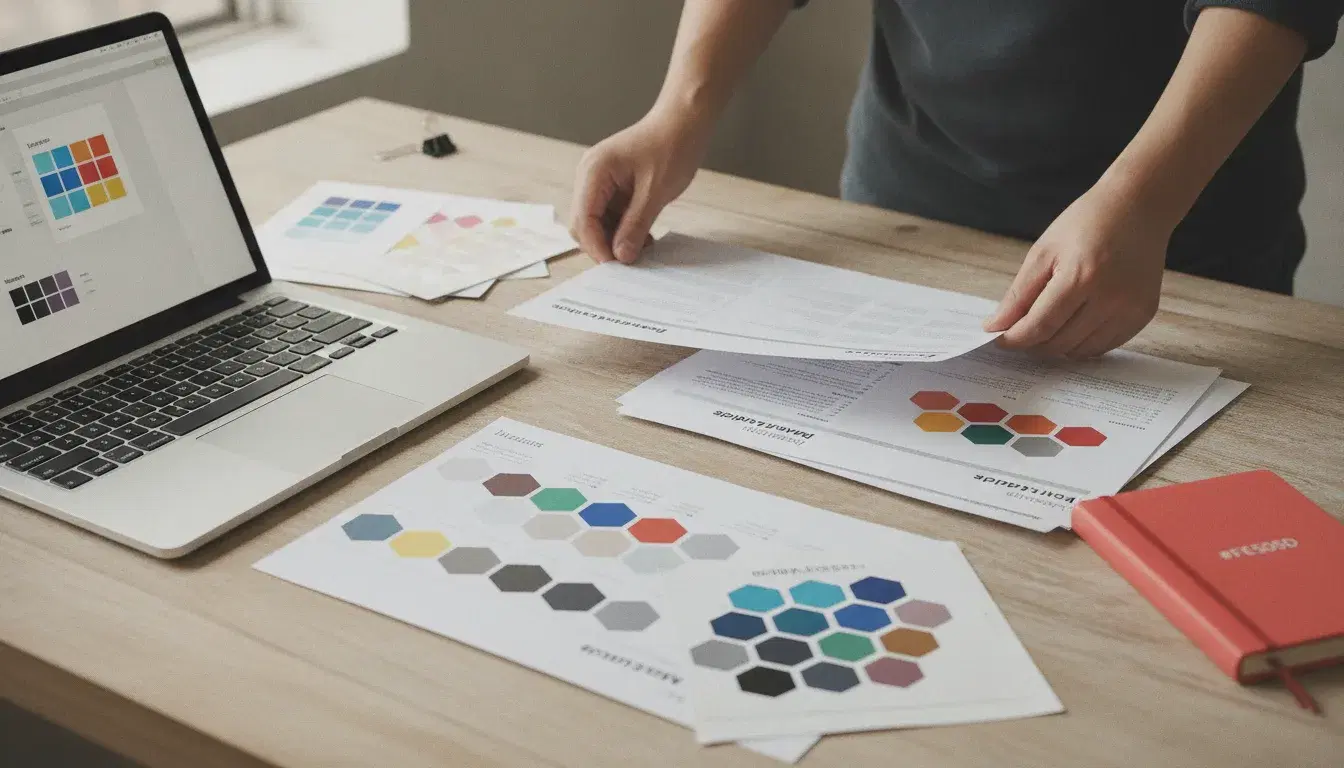
A logo alone does not protect a brand. What protects a brand is a document that everyone actually respects: your printer, your web agency, your social media manager, and the new sales rep you hire in March. According to a Marq (formerly Lucidpress) study, consistent brand presentation across all channels can increase revenue by 10 to 20 percent. And according to Capital One Shopping Research, 33 percent of businesses report a revenue increase of 20 percent or more thanks to this visual consistency alone. So the problem is almost never the absence of a style guide: it is a style guide that is too vague, too focused on aesthetics, and not usable enough for providers to actually follow it day to day.
Why a poorly built style guide costs more than it saves
According to Digital Silk, 95 percent of companies already have brand guidelines, but only 25 percent actually apply them in their everyday communications. The gap between those two figures has a direct cost: every provider who lacks clear information invents their own interpretation. A social media manager crops the logo differently, a printer approximates a Pantone color in CMYK, a freelancer picks a substitute font because no one told them which one is authorized. After twelve months, the brand looks like a visual patchwork that erodes customer trust far more surely than an imperfect but consistent identity.
For a small or mid-sized business, this is not an aesthetic issue, it is an economic one: every visual inconsistency adds friction to the buying journey, and every file reworked by a provider who did not have the right information is billed as wasted hours.
The 8 elements a style guide actually needs to contain
A usable style guide is not a moodboard. It is a technical document that answers, without ambiguity, the question every provider asks: what am I allowed to do, and how?
1. The logo and its protection zone
All approved variations (full color, monochrome, light background, dark background), the minimum display size below which it becomes unreadable, and most importantly the protection zone: the mandatory empty space around the logo that no one should ever fill, not even with a tagline or a social media icon.
2. The color palette with every code
Not a color swatch on a screen, but the exact codes in every system: HEX for the web, RGB for screens, CMYK and ideally a Pantone reference for print. Without these three formats, a printer and a web developer will end up with two different shades of the same color.
3. A clear typographic hierarchy
The heading font, the body text font, and a free fallback font in case the brand's main font is paid or unavailable on certain platforms, as detailed in our guide to choosing brand typography.
4. Forbidden uses, shown through counter-examples
This is the most commonly missing element, and the most useful one: concretely showing what not to do (a stretched logo, inverted colors, a replaced font) is far more effective than a list of abstract rules.
5. Applications across every medium
Website, social media, email signature, business card, vehicle, signage: each medium has its own constraints, and a complete style guide anticipates these uses rather than leaving them to improvisation, as explained in our guide to multi-channel visual identity.
6. Brand voice and vocabulary
A style guide that stops at visuals leaves a gaping hole: how does the company express itself in writing? Formal or informal tone, words to avoid, level of formality. This section prevents a social media manager and a customer service team from sounding like two different companies.
7. Image and iconography rules
The approved photography style (natural light or studio, presence of people or not), icon treatment, and reference image libraries to keep visual consistency beyond the logo alone.
8. Technical information for providers
File formats (SVG, EPS, PNG, vector PDF), minimum resolutions for large-format printing, and centralized access to source files. Without this last part, even the most beautiful style guide stays purely theoretical.
How to structure the document so it actually gets used
A 40-page PDF that nobody opens protects no brand at all. For a small or mid-sized business, three formats work better than a single, frozen document: a one- to two-page summary with the essential rules (logo, colors, typography) to hand to every new provider; a complete document detailing the eight elements above for major projects (website redesign, new product line); and, if budget allows, a component library (Figma or equivalent) that the agency designing your materials can reuse directly.
One often overlooked point: assign one person as the owner of the document's updates. Without a clear owner, a style guide becomes outdated the moment a color or tagline changes, and nobody knows which version is the current one.
How much time and budget to plan for
According to the agency Kolonell, you should plan on average 3 to 5 weeks for a minimal mini style guide covering the essentials, 6 to 10 weeks for a standard small-business style guide covering all common media, and 10 to 16 weeks for a complete style guide delivered with a reusable component library. To estimate the budget for creating or redesigning these elements, our complete guide to logo and style guide redesign budgets breaks down the typical ranges by company size.
Briefing your providers: the real test of a style guide
A style guide is only good if it holds up against a provider who knows nothing about your company. Before approving it, test it literally: hand the document to an outside designer or web agency with no further explanation, and ask them to produce a simple asset (a banner, an email signature). If they need to ask you more than three questions, something is missing. This echoes the approach in our guide to briefing a graphic designer: the more precise the reference document, the less time and money is lost in back-and-forth revisions.
Once your visual identity is stable, also think about protecting it legally: our guide to trademark registration with the INPI explains the steps needed to stop a competitor from claiming your logo or your distinctive colors.
Mistakes that make a style guide unusable
- Too much aesthetics, not enough rules: a beautiful document that specifies no exact color code or protection zone is useless in practice.
- No example of forbidden use: without a visual counter-example, every provider reinterprets the rules their own way.
- A single format unsuited to every use case: a 50-page PDF sent to a social media manager who needs an answer in thirty seconds will never get opened.
- No designated owner: without a clear owner, nobody knows if the version they received is the latest one.
- Forgetting secondary colors and uses: a palette limited to the logo alone leaves every secondary element (buttons, icons, backgrounds) to improvisation.
If your current logo already shows signs of fatigue even before thinking about the style guide around it, our guide to logo redesign explains how to modernize a visual identity without losing the recognition you have built with your customers.
For the design or redesign of these materials, the Majoli design studio team supports small and mid-sized businesses across France, from the first graphic mockups all the way to the delivery of the complete document.
Frequently asked questions
What is the difference between a style guide and a brand book?
A style guide focuses on visual rules: logo, colors, typography, and their technical uses. A brand book goes further: it also includes brand strategy (mission, values, voice, positioning). In practice, for a small or mid-sized business, the two documents are often merged into one, as long as it covers both dimensions.
At what company size does a style guide become essential?
Once a company has more than 5 to 10 employees or communicates across more than two channels (website, social media, printed materials), the absence of a style guide mechanically leads to visual inconsistency, with each person interpreting the brand identity their own way.
Should it be a Word document, a PDF, or a tool like Figma?
All three can coexist: a PDF or simple document for quick distribution to occasional providers, and a Figma library for agencies that regularly produce your materials and need components they can reuse directly in their designs.
Who should be responsible for updating the style guide?
Ideally a single person internally, often in marketing or management, in charge of approving every change and distributing the latest version. Without this role clearly assigned, several versions of the document circulate at once and inconsistencies creep back in.
Is a style guide enough to legally protect my logo?
No. A style guide organizes how your visual identity is used internally and by your providers, but it does not provide legal protection. To stop a third party from using a similar logo or colors, registering a trademark with the INPI (or the relevant authority outside France) remains necessary.
Read next

October 7, 2026
AI and Accounting for Small Businesses: Automating Data Entry and Bank Reconciliation in 2026
46% of accountants use AI daily, up from 18% in 2023 (Sage). The 5-step method to automate invoice entry, bank reconciliation and pre-categorization in 2026.
October 6, 2026
Business Registration for Liberal Professions: The Rules to Know in 2026
1.7 million liberal businesses in France, according to UNAPL. Lawyers, doctors, consultants: registration rules vary by profession. The complete guide to choosing the right solution in 2026.

October 2, 2026
Retargeting for Small Businesses: Re-Engage Visitors Without Risking a CNIL Fine in 2026
French regulators issued 487 million euros in cookie fines in 2025. The complete, GDPR-compliant guide for small businesses to launch a profitable retargeting campaign in 2026, step by step.